UCL CCC Hackathon
A deep learning model that fuses MRI scans and methylation array data to improve tumor subclass diagnosis, surface clinically meaningful imaging features, and generalize across diverse clinical datasets.
Project Overview
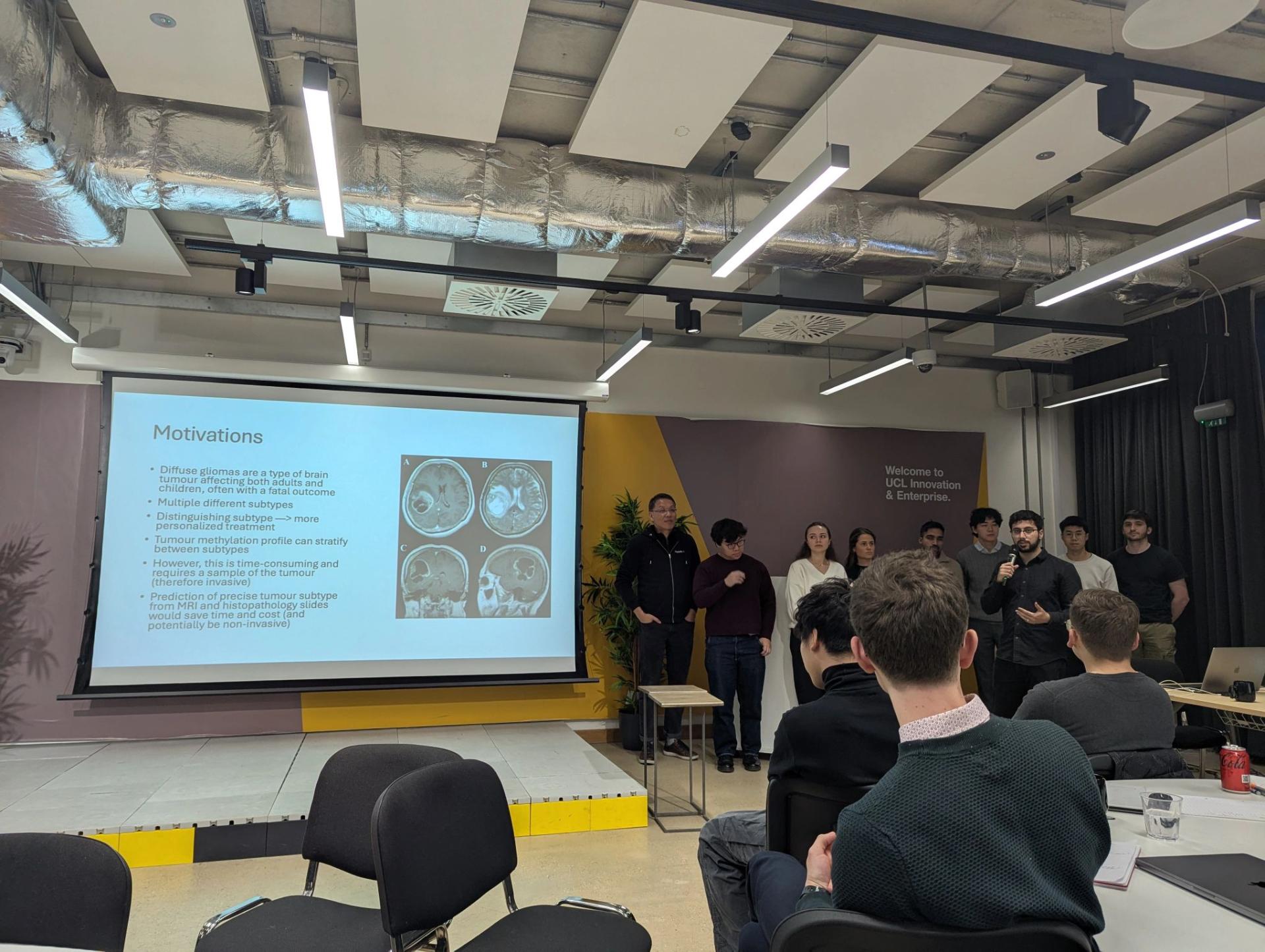
At the inaugural UCL Computational Cancer Collaboratorium Hackathon in December 2024, I contributed to a team project bridging computational science and cancer research. We developed a deep learning pipeline to enhance tumor diagnosis and classification by combining two complementary data modalities: structural information from MRI scans and molecular signals from methylation array data.
The goal was to move beyond single-modality models and build a system that could both classify tumor subclasses with greater accuracy and explain which imaging patterns drive those predictions — giving clinicians richer insight into how different tumor types present on scan.
The Problem
Tumor subclassification is critical for prognosis and treatment planning, but diagnosis often relies on fragmented evidence across imaging and molecular assays. MRI captures spatial and morphological features, while methylation profiles encode epigenetic patterns linked to tumor biology. Without integrated models, valuable cross-modal signals can be missed, and models trained on one hospital's imaging protocol often fail when applied elsewhere due to inconsistent preprocessing and scanner variability.
Key Features
- Multimodal tumor classification: Paired MRI and methylation array inputs to diagnose tumor subclasses with greater accuracy and precision.
- Interpretable MRI features: Identification of critical imaging regions and patterns that highlight tumor subclass, supporting more actionable clinical insights.
- MRI normalization pipeline: Tools to standardize MRI data from new sources, reducing domain shift and enabling the model to generalize across diverse datasets and clinical environments.
- Hackathon sprint workflow: Rapid prototyping under real multidisciplinary constraints — working alongside clinicians, scientists, and engineers on a live cancer research challenge.
Technologies Used
- Python for data processing and model development
- Deep learning frameworks (PyTorch / TensorFlow) for multimodal classification
- MRI preprocessing and normalization tooling for cross-site standardization
- Methylation array feature engineering and fusion with imaging embeddings
- Jupyter notebooks for exploratory analysis and hackathon iteration
Results & Impact
The project demonstrated that combining MRI and methylation data can strengthen subclass prediction while surfacing imaging features clinicians can relate to. The normalization tooling was a practical step toward deployment — addressing one of the main barriers to translating research models into settings with heterogeneous scan protocols.
The hackathon reinforced how multidisciplinary collaboration — pairing computational methods with domain expertise in neuroradiology and cancer biology — accelerates progress on problems that neither imaging nor genomics alone can fully resolve.