Interconnected Actuation Networks for Shape-Shifting Robots
MSc research on embedded SMA actuator subnetworks and NSGA-II optimisation to reduce control dimensionality in morphing robotic systems.
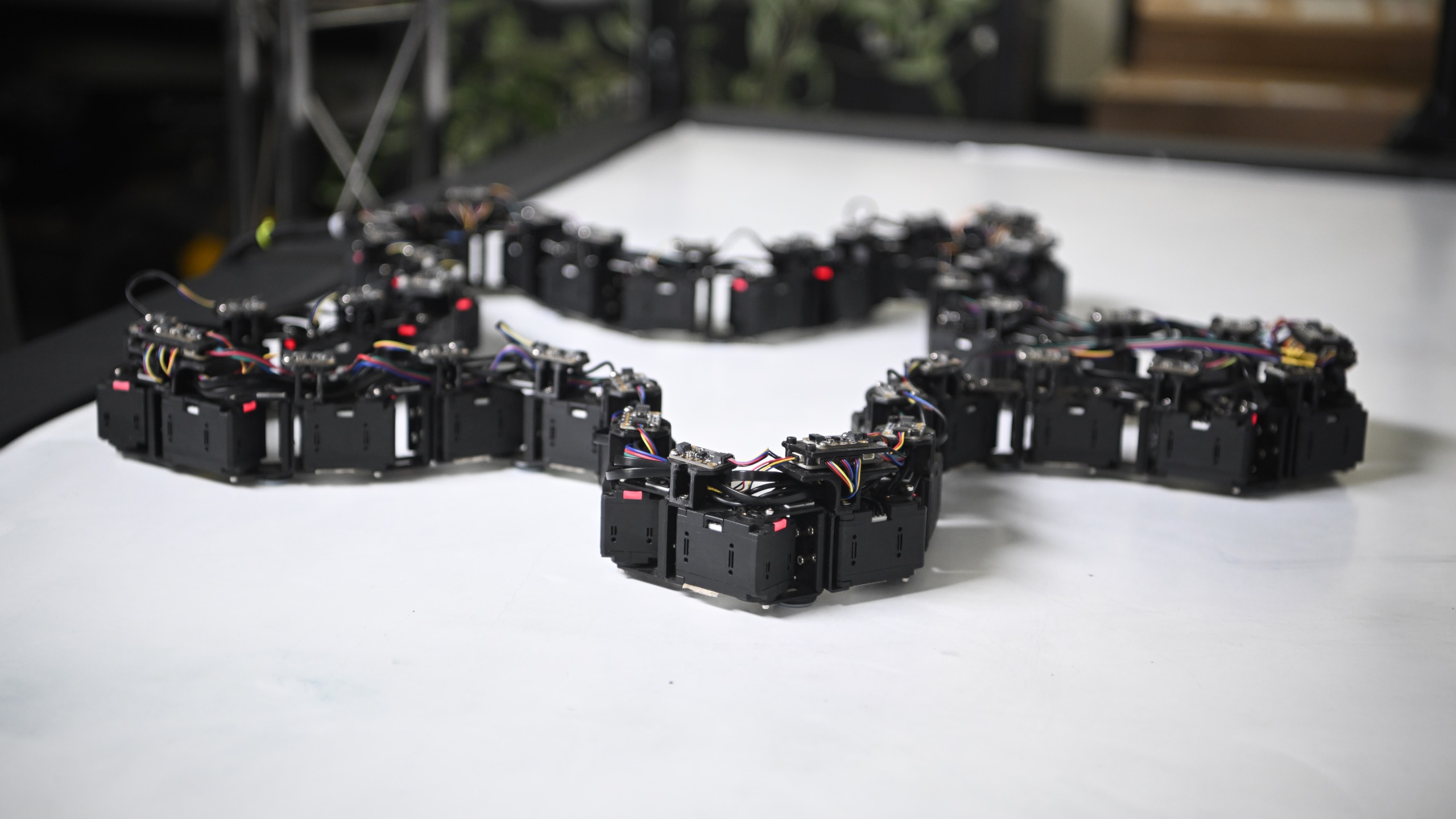
Image: Loopy polymorphic robot testbed, West Virginia University. Smith, T., Butts, R. M., Adkins, N., & Gu, Y., Swarm of One: Bottom-up Emergence of Stable Robot Bodies from Identical Cells, arXiv:2306.12629 (2023).
Research Question
How can actuator networks be partitioned into physically meaningful subnetworks to reduce control dimensionality while preserving morphing capability?
Project Overview
This MSc project, supervised by Majid Taghavi, develops and experimentally validates a scalable actuation architecture for thermomechanically coupled shape memory alloy (SMA) systems. Rather than treating every actuator as an independent control input, the work embeds actuators into coupled subnetworks — C-networks — that reduce N inputs to K control channels while preserving global morphing behaviour.
The approach combines a modular hinged tetrahedral truss robot design with multi-objective genetic optimisation (NSGA-II) to assign actuator groupings under symmetry and connectivity constraints before deployment.
Background & Motivation
As actuator count increases in shape-shifting robots, control dimensionality scales proportionally (N actuators → N control inputs). This leads to increased computational burden, coordination difficulty, and instability. Most existing approaches treat actuators as independently controlled elements, limiting scalability in large morphing systems.
Architectural restructuring is therefore required to reduce control complexity while preserving mechanical expressivity — building on variable-geometry truss (VGT) systems demonstrated by Gu et al. in Nature Communications (2025).
Objective
To develop and experimentally validate a scalable actuation architecture for thermomechanically coupled SMA systems that reduces effective control dimensionality through physically embedded subnetworks while preserving global morphing capability.
Robot Design
- Geometry: Modular hinged tetrahedral truss (15 × 15 × 15 mm unit cell)
- Structure: Rigid tubular members with pin and rotational joints
- Actuators: 0.8 mm NiTi SMA wires routed axially through selected members
- Anchoring: Joint nodes with passive bias elements for elastic restoring force during SMA cooling
- Control: C-networks reducing N inputs to K channels
- Optimisation: NSGA-II assigns actuator subnetworks under symmetry and connectivity constraints prior to deployment
- Actuation: Controlled electrical currents via PWM MOSFET drivers
MVP #1 — Single NiTi Actuator Characterisation
Before scaling to interconnected subnetworks, the first experimental milestone characterises the fundamental thermomechanical behaviour of a single NiTi actuator under controlled electrical stimulation.
Aims
- Characterise contraction, response time, and repeatability under controlled electrical stimulation
- Establish baseline metrics for scaling into an interconnected subnetwork of actuators
Hypothesis
- Increasing temperature above the austenite phase using electrical currents induces transformation and contraction
- Recovery time post-actuation will be longer than contraction time, limiting achievable actuation frequency
Experimental Evaluation
- Displacement measured using optical tracking
- Performance evaluated by contraction size, response time, recovery time, and repeatability
- Setup uses a bias spring and laser displacement measurement system (adapted from Tsai et al.)
Quantitative Performance
- Rotation angle scales with pre-strain, matching predictions
- Amplification factor (≈3.2×) enables >10° actuation from modest NiTi strain recovery (<7%)
Sub-Network Optimisation (NSGA-II)
A multi-objective evolutionary search identifies valid actuator subnetworks in a large, discrete design space under structural constraints. Pareto ranking balances morphing performance, control dimensionality, and physical feasibility.
Each design encodes:
- C-network assignment (which actuators act together)
- Contraction levels for individual actuators
- Activation timings for each subnetwork
The pipeline follows: initialise population → evaluate objectives → non-dominated sorting → diversity preservation → selection → crossover and mutation.
Conclusion
Physically coupled SMA subnetworks reduce control dimensionality while preserving morphing capability. Optimised actuator grouping enables scalable, low-dimensional control of shape-shifting robotics.
Applications
- Terrain-adaptive robotic mobility
- Assistive and therapeutic morphing platforms
- Safe and adaptive construction and inspection systems
Technologies & Methods
- NiTi shape memory alloy (SMA) actuators
- Hinged tetrahedral truss morphing structures
- NSGA-II multi-objective genetic algorithm
- PWM MOSFET driver circuits
- Optical displacement tracking
- Variable geometry truss simulation and validation
References
- Smith, T., Butts, R. M., Adkins, N., & Gu, Y., Swarm of One: Bottom-up Emergence of Stable Robot Bodies from Identical Cells, arXiv:2306.12629 (2023) — Loopy testbed (project image)
- Tsai et al., J. Micromechanics and Microengineering, 2018 — SMA actuator characterisation setup
- Gu et al., Nature Communications, 2025 — Optimisation and control of actuator networks in VGT systems
- Deb et al., IEEE Trans. Evolutionary Computation, 2002 — NSGA-II algorithm
- Sofla et al., Smart Materials and Structures, 2009 — Shape morphing hinged truss structures